
Software
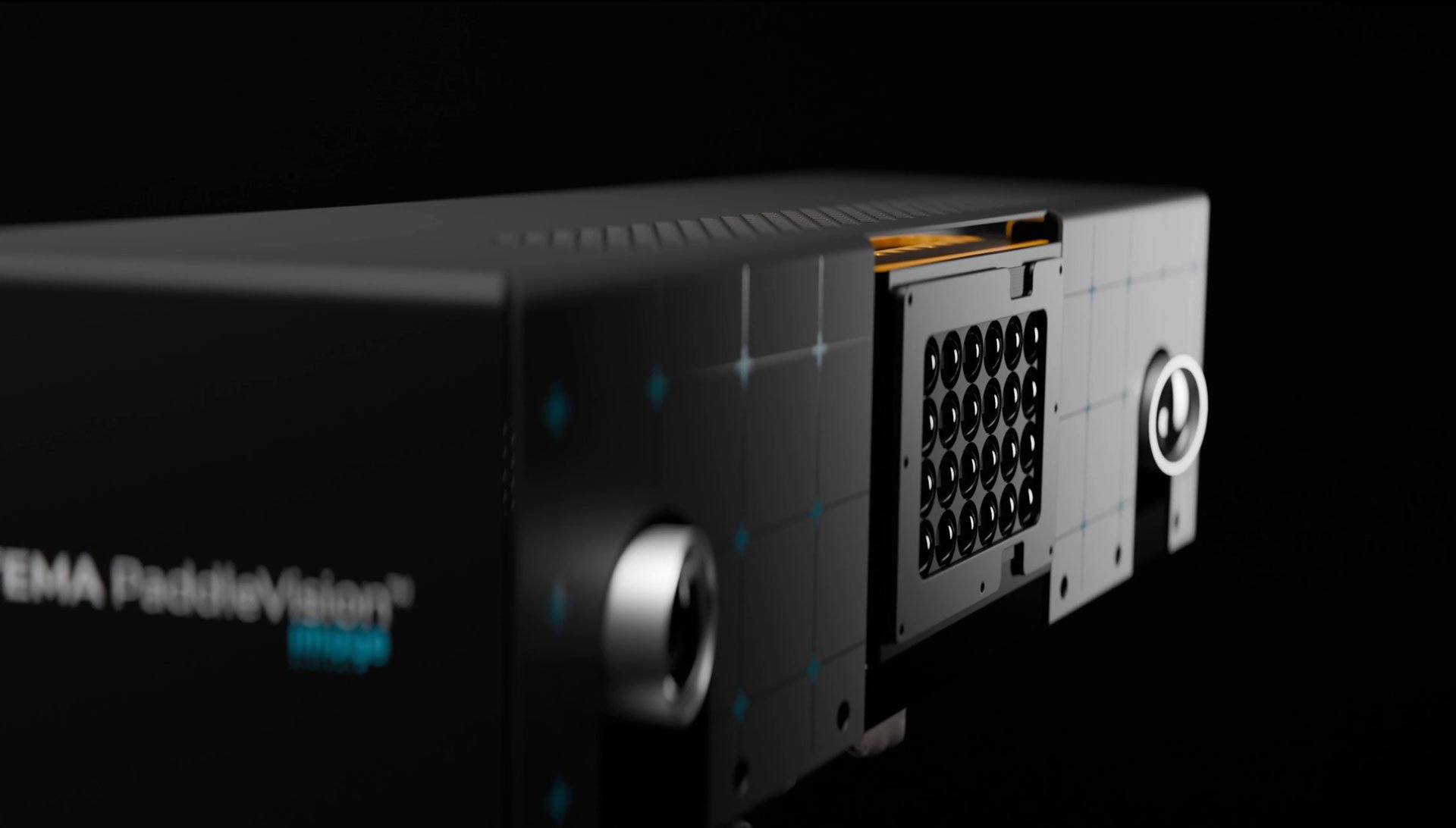

PaddleVision measures paddle spin by filming a marked ball with two synchronized high-speed cameras, rebuilding the ball’s position and orientation in 3D for every frame, and calculating how fast that orientation changes. The result is a single spin rate in RPM, produced automatically, with no one judging the footage by eye.
Deterministic, reproducible and automated analysis.
 That number now carries real weight. Since October 1, 2026, paddles submitted for USA Pickleball certification must spin the ball at less than 2,100 RPM in the Spin Rate Test. USA Pickleball built that test on PaddleVision technology, developed over more than a year with Image Systems and Franklin Sports.
If you design or build paddles, it helps to know what happens between “ball leaves the cannon” and “RPM appears on screen”. Let's look step by step at what happens in the PaddleVision pipeline.
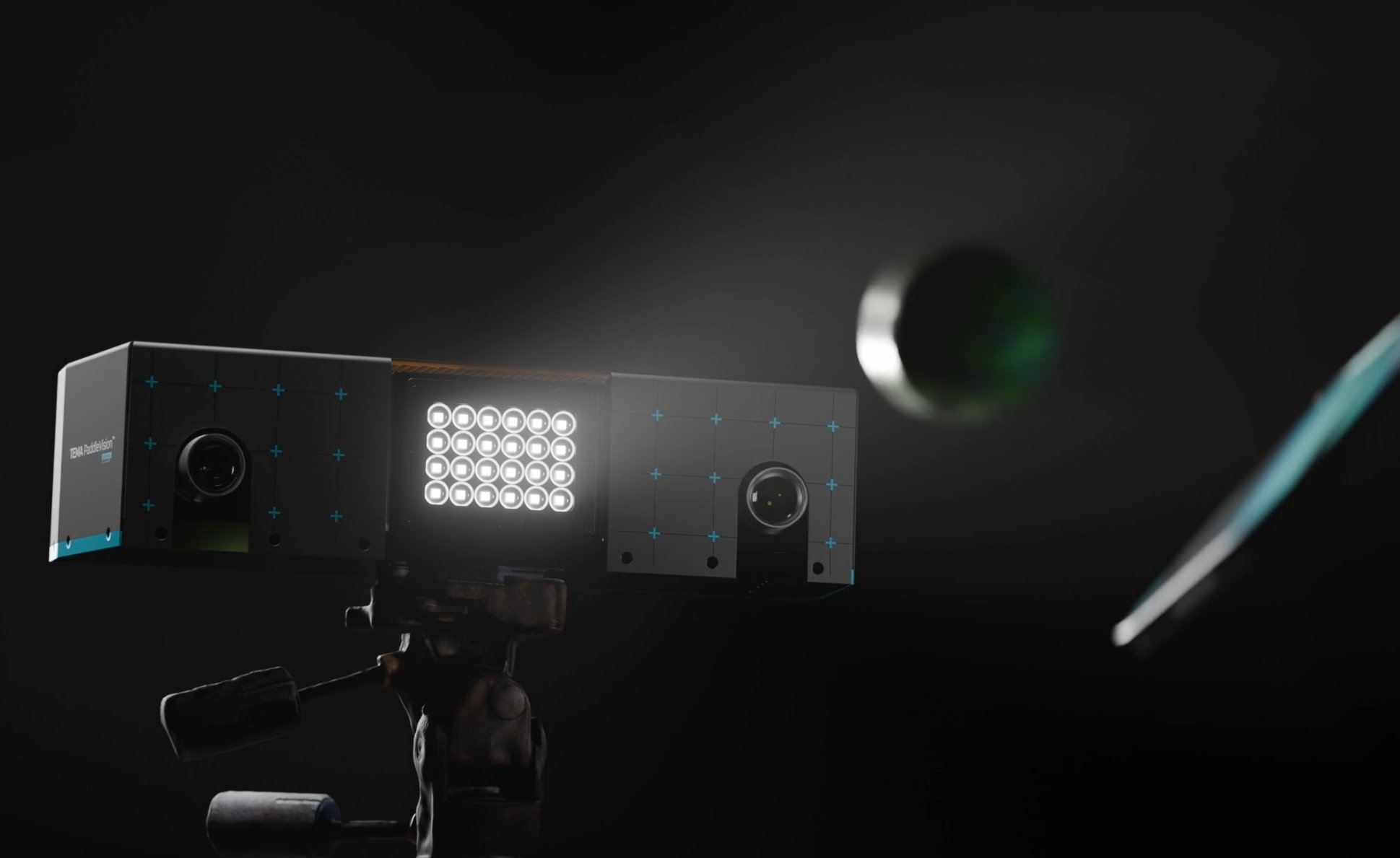
A ball is fired from a cannon at a paddle held in a fixed position. The PaddleVision system with two high-speed cameras and built-in lighting films the ball as it comes in, hits the paddle face, and leaves. The cameras trigger simultaneously from a sensor signal, so every frame from one camera has a matching frame from the other.
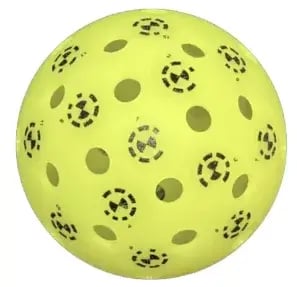
The ball is not an ordinary pickleball. It carries printed tracking markers in a precise layout, and the software knows exactly where each marker sits on the sphere in 3D-space. Franklin Sports developed a way to print those markers on a curved surface without distortion, consistently from ball to ball. This known geometry is what lets the software work out the ball’s exact orientation from a subset of the points.
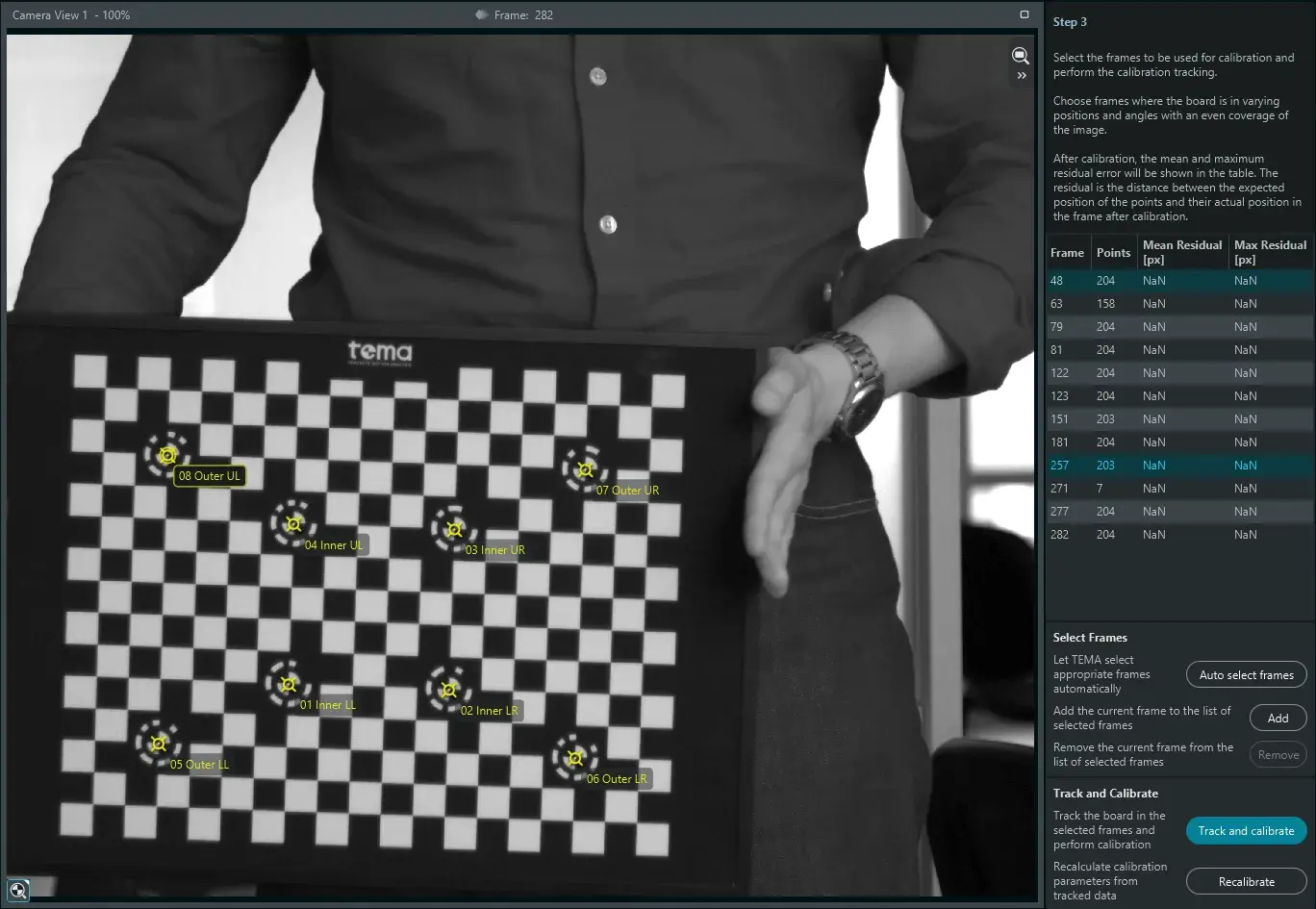
Before testing, the two cameras are calibrated against each other. Calibration gives the software each camera’s position and viewing angle in relation to the other, so a point seen in both views can be triangulated into a point in 3D space. The calibration covers the whole field of view, so the calibration board does not have to sit where the ball actually travels.
The TEMA Paddle software runs seven steps through an operator-friendly wizard. The operator triggers the shot; everything after that is automatic.
The last value out of step 7 is the average spin rate, in RPM or degrees per second dependent on the operator needs.
It checks the data automatically, at three levels. High-speed footage may show things that look like markers but aren’t. A common one is the edge of one of the ball’s holes, which can read as a dot. Because the software knows the ball’s exact geometry, a dot in the wrong place stands out at once and is thrown out before it reaches the 3D model.
The motion filter and the outlier test (steps 5 and 7) then catch anything subtler, such as a marker that jumps or swaps places for a single frame. A brief glitch like that does not move the final RPM. No one scrubs through frames correcting points by hand, so the same paddle goes through the same process in any lab.
What is the USA Pickleball spin rate limit?
Paddles certified on or after October 1, 2026 must produce less than 2,100 RPM in the USA Pickleball Spin Rate Test.
What technology does the USA Pickleball Spin Rate Test use?
The test uses PaddleVision, a dual-camera high-speed motion-analysis system from Image Systems, with a marked test ball manufactured by Franklin Sports.
How accurate is PaddleVision?
Image Systems reports a mean error of 0.069% in total spin, using sub-pixel tracking and sub-millimeter calibration. The system measures spin rates up to 5,000 RPM.
Does an operator have to interpret the footage?
No. Marker tracking, error filtering, 3D reconstruction, and the RPM calculation all run automatically. The operator sets up the paddle and fires the ball.
What is 6DoF analysis?
Six degrees of freedom means the software tracks both where the ball is (three directions) and how it is rotated (three axes) in every frame. Spin is calculated from the rotation part.
How many frames does a spin test need?
Typical tests capture 25 to 35 frames. Results are considered accurate above 7 frames.
Can manufacturers run the spin test in-house?
Yes. Manufacturers can use PaddleVision to test prototypes and paddles before submitting them for certification.
Every step above runs the same way whether the test happens in a certification lab or in your own R&D space. That means you can find out where a prototype lands against 2,100 RPM weeks before you submit it, compare surface textures and cores on real numbers, and check that production runs stay consistent.
See how PaddleVision works for paddle manufacturers, or book a demo to see a spin test run live.