
Faster USAP certification
Accelerate USAP compliance and product launches.

When USA Pickleball established its new 2,100 RPM spin rate certification requirement, it used PaddleVision technology to accurately measure and validate paddle spin performance.

Our services
Accelerate USAP compliance and product launches.

Ensure every paddle meets your standards.
Make better design decisions with reliable data.
Measure performance wherever you need it.
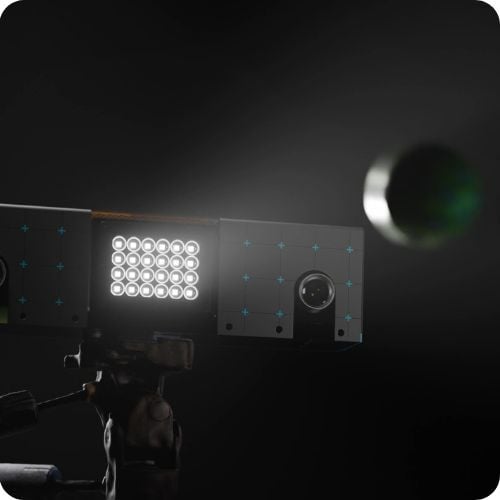
PaddleVision is a compact dual-camera embedded system with built-in lighting to automatically capture and analyze ball movement and rotation during paddle testing.
Purpose-built software for pickleball paddle testing. Automatically analyze spin rate, velocity, and ball behavior through an intuitive interface, helping teams make faster development decisions and streamline certification testing.
Custom transport cases and integrated wheels. Designed for single-person transport between facilities or testing locations.
Pre-configured workflows with point-and-shoot capture, automated analysis, and instant reporting. Streamlined testing that delivers consistent, repeatable measurements.
Meet industry standards and accelerate your time to market with automated compliance testing and reports ready to export and send for certification.
Sub-millimeter calibration, sub-pixel tracking, and a mean error of 0.069% RPM total spin precision ensure QA and manufacturing consistency. Measurements up to 5000 RPM with advanced 6-Degrees-of-Freedom analysis.
PaddleVision is designed for R&D managers, project engineers, and technicians who need reliable, repeatable testing, delivering standards-compliant measurements and actionable insights that help optimize paddle performance while controlling development costs.


Compare prototypes, evaluate materials, and understand how design changes affect spin performance. PaddleVision provides immediate, objective feedback that helps teams make faster development decisions and reduce costly design iterations.

USA Pickleball's new certification requirement limits pickleball paddles to a maximum spin rate of 2,100 RPM (revolutions per minute). Manufacturers must ensure their paddles remain within this threshold to achieve certification for sanctioned play. This makes spin-rate testing an essential part of product development and compliance verification.
Yes. PaddleVision technology was used by USA Pickleball to measure and validate paddle spin performance when establishing the new spin-rate standard. Manufacturers can use the same proven technology to evaluate prototypes, support product development, and prepare for certification testing with greater confidence.
The new rule introduces spin rate as a measurable certification requirement. Manufacturers must now verify that paddle designs remain below the 2,100 RPM limit before submission, reducing the risk of failed certifications, launch delays, and costly redesigns.
PaddleVision delivers highly accurate and repeatable measurements using synchronized high-speed cameras and advanced motion analysis. The system provides within 0.069% RPM total spin precision, and within 0.074% Coefficient-of-Restitution precision, with sub-pixel tracking and full 6DoF analysis for reliable testing and quality assurance.
The operator places the paddle, launches the ball, and PaddleVision automatically captures the impact using synchronized high-speed imaging. TEMA Paddle software then analyzes ball movement and rotation, reoconstructing the ball pose each frame, providing instant spin-rate and PBCoR-like results that can be exported to PDF or CSV.
Manufacturers can use PaddleVision to perform accurate spin-rate testing in-house throughout the development process. By identifying performance issues early, teams can refine designs, validate compliance, and reduce the need for repeated external testing before certification submission.
Results are available immediately after each test. PaddleVision automatically captures, analyzes, and reports performance data without manual calculations, allowing manufacturers to test more prototypes, make faster development decisions, and accelerate time to market.